What water damage restoration actually costs.
Almost nobody in this industry will put a number on a web page. Here it is: what national cost guides report for real jobs, the eight variables that decide where yours lands, and what insurance pays versus what comes out of your pocket. Our assessment is free and quoted in writing before any equipment comes off the truck.
- Free assessment
- Written quote before work
- Insurance documentation included
Water damage restoration cost in Orange County: the range, and why it's a range.
National home-services cost guides that aggregate contractor invoices put typical U.S. water damage restoration between roughly $1,300 and $6,400, averaging near $3,900. Mitigation work is normally priced by the affected square foot, and those same guides cluster in the neighborhood of $3 to $8 per square foot depending on how dirty the water was and how deeply it soaked into the structure.
Read those as market context, not a FlexPro price list. Two 400-square-foot losses on the same street can differ by thousands: one caught in ninety minutes on tile, the other found after a long weekend with saturated pad, wet drywall and a mold problem. What we do commit to: the assessment is free, the quote is itemized and written, and you approve the number before work starts. Here's what moves it.
The eight things that decide your number
1. The category of water: clean, grey or black
This is the single biggest multiplier, and it has nothing to do with how much water there is. Category 1 is clean water from a supply line, water heater or overflowing tub. Category 2 is grey water: washing machine and dishwasher discharge, or a toilet overflow without solids. Category 3 is black water: sewage backups, groundwater from outside, or any water that sat long enough to grow its own biology.
Cost guides typically show clean-water work near $3.75 per square foot, grey water near $4.50, and black water near $7.00. The jump isn't a markup; the job changes shape. Category 3 means containment, protective equipment, regulated disposal, and porous materials getting removed instead of dried: pad, insulation and the lower two feet of drywall go in the dumpster, not under an air mover.
2. The class of loss: how much material drank the water
Losses are also graded by how much of the structure absorbed the intrusion. Class 1 is minimal absorption: part of one room, mostly hard surfaces. Class 2 is a whole room with carpet and pad, water wicking up the walls. Class 3 came from overhead, so ceilings, walls and insulation are all in play. Class 4 is bound water in low-evaporation materials: hardwood, plaster, concrete, stone. It needs specialty gear (drying mats, injection systems, desiccants) and more days on site, which is why identical-size rooms carry very different invoices.
3. Square footage actually affected
Mitigation is quoted per affected square foot, and "affected" is bigger than the room you're standing in: the footprint under cabinets and appliances, the wall cavities the water climbed, any adjacent space it reached through the subfloor. A 200-square-foot bathroom and a 1,200-square-foot first floor aren't six times apart in price, though; setup and disposal don't scale linearly, so the per-foot rate usually drops as area grows.
4. How long it sat before mitigation started
This is the one variable you control, and it's worth more than any coupon. The same burst supply line caught in two hours is an extraction-and-dry job. Found after a weekend away, it's a demolition job: pad gone, drywall wicked past the point of drying in place, subfloor saturated, and the mold clock (24 to 48 hours) already run out. Every hour of standing water quietly moves line items from the "dry it" column to the "replace it" column. If water is moving right now, stop reading and call 1-877-GO-FLEX7.
5. What got wet
Materials decide how much can be saved instead of replaced, and salvage is where the money is:
- Carpet and pad: the pad is almost always pulled and replaced because it's cheap and holds water like a sponge; the carpet itself is often savable on a clean-water loss caught early
- Hardwood: the most expensive floor to save and the most expensive to lose; specialty mat drying costs real money per day but is still far cheaper than a full replacement
- Engineered wood and laminate: usually not salvageable once the core swells or delaminates
- Tile and stone: the surface almost always survives; the underlayment and subfloor beneath it may not
- Drywall: dries in place if caught fast, otherwise gets flood-cut at two or four feet, which pulls painting and texture into the reconstruction scope
- Cabinetry and vanities: toe-kicks get drilled and directed airflow goes underneath; particleboard boxes that swelled are typically a loss
- Batt insulation: wet insulation is removed, never dried, and it's cheap to replace but adds demolition labor
6. Equipment days
Drying equipment is billed per unit per day, which is why this phase quietly becomes the largest line on many mitigation invoices. Published ranges put air movers around $25 to $85 per unit per day and refrigerant or LGR dehumidifiers around $50 to $180 per day. A wet bedroom might get three or four movers and one dehumidifier; a saturated first floor can take fifteen to twenty movers and several dehumidifiers running three to five days.
This is where an honest contractor saves you money. Equipment should come out when daily readings hit dry standard, not two days later because nobody came back to check. Ask for the moisture log. If they don't keep one, that's your answer.
7. Whether mold remediation is now in scope
Once growth is established, mold is its own project at its own price: containment, negative air, HEPA filtration, controlled removal and post-remediation verification. Public cost guides put remediation around $10 to $25 per affected square foot, with typical residential projects roughly $1,100 to $3,400 and anything touching HVAC or a crawlspace higher. Insurance treats it differently too: many policies carry a mold sublimit far below the water coverage, and coverage often disappears if the source was a slow leak rather than a sudden failure. That's the whole argument for speed. More on our Orange County mold removal page.
8. Mitigation versus reconstruction: the two-invoice surprise
Most homeowners find this out on day four. Mitigation is the emergency phase: extraction, structural drying, antimicrobial treatment, and removal and disposal of anything unsalvageable. Reconstruction is putting the house back together: drywall, texture, paint, baseboards, flooring, cabinets. Separate scopes, priced separately, and insurers scope them separately.
The published $1,300–$6,400 range is mitigation-weighted; rebuilding the room is its own number on top. So whenever anyone quotes a single figure, including us, ask: does that include putting it back? Our written quote says which scope each line belongs to.
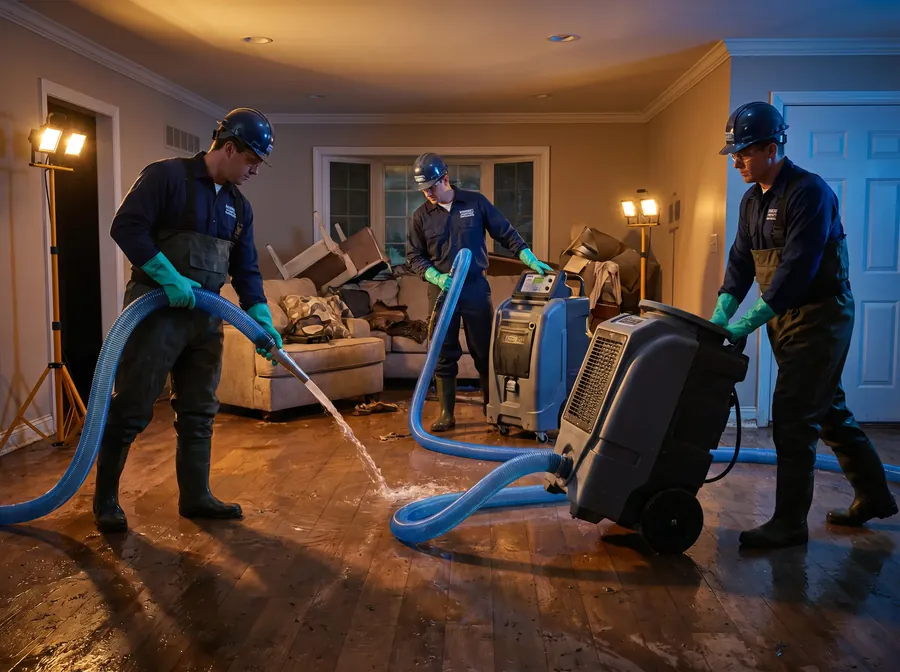
What your insurance likely pays, and what you actually pay.
The number on the invoice is rarely the number that leaves your bank account. On a covered loss, what matters is your deductible and how your carrier releases money.
- Sudden and accidental is the test: a burst pipe, a failed water heater, a supply line that let go behind the dishwasher is normally covered. Long-term seepage from a drip you'd lived with is not
- Your deductible is the usual out-of-pocket: typical homeowners deductibles run about $500 to $2,500, charged once per claim, not per room or per phase
- Do the math before you file: a $6,000 loss against a $1,000 deductible is a clear claim; an $1,800 loss against a $1,500 deductible often isn't worth the claims history
- ACV first, depreciation later: many carriers release actual cash value up front and hold recoverable depreciation until repairs are finished and receipts submitted, so the money arrives in two pieces
- Rising water is a different policy: water entering from outside the home is excluded from standard homeowners coverage and requires separate flood insurance
- Mold usually has its own ceiling: sublimits are common, another reason speed protects your wallet and not just your drywall
- Documentation is what gets paid: adjusters approve on evidence: time-stamped photos, moisture readings, an itemized scope. Ours goes to you either way
We walk adjusters through losses on-site and by phone all week. If you're weighing whether to file at all, the full breakdown of what's covered, what isn't, and how to open a claim sits on our water damage insurance claims page.
How to keep the cost down, starting in the first hour.
Almost everything that saves money on a water loss happens before a restoration truck arrives. None of it requires expertise, and all of it beats negotiating on the back end.
- Shut off the source, then call immediately: the water main if it's a supply failure, the angle stop if it's a fixture. Hours, not days, decide whether materials get dried or demolished
- Photograph and video before you move anything: wide shots of each room, close-ups of standing water, serial numbers on damaged appliances. The cheapest thing you can do for your claim
- Don't throw anything away yet: ruined rugs, soaked furniture, warped baseboard. Adjusters can't reimburse what they never saw. Photograph it, bag it, set it aside until it's documented
- Don't try to dry it yourself: box fans and a rented shop vac move surface water and leave the wall cavity, pad and subfloor wet. A structure that looks dry but reads wet is how a $2,000 job becomes a mold job
- Keep every receipt: fans, a hotel night, an emergency plumber. Additional living expenses and emergency mitigation costs are frequently reimbursable
- Ask for mitigation and reconstruction as separate written scopes: it keeps the estimate readable, keeps your adjuster moving, and makes it obvious if a line item drifts
- Get the moisture log: daily readings prove the structure was dried to standard. It protects the claim now and protects you if a buyer asks in five years
If water is spreading right now, this isn't a cost conversation yet. See emergency flood cleanup across Orange County, or what the first four days look like on our water damage restoration in Irvine page.

Every hour of standing water raises the number.
Extraction started today is cheaper than demolition started Friday. Our line is answered 24/7 across Orange County.
Water damage cost questions.
The things homeowners ask once the panic has passed and the estimate is on the table.
National cost guides put typical U.S. water damage restoration between roughly $1,300 and $6,400, averaging near $3,900, with mitigation commonly quoted at $3 to $8 per affected square foot. Those are market figures, not a FlexPro price list; a single wet bathroom lands near the bottom, a contaminated whole-floor loss lands well above the top. Our on-site assessment is free and you get an itemized written quote before any equipment comes off the truck.
Category 3 water is handled as a biohazard, so the work changes shape: containment, protective equipment, regulated disposal, and removal rather than drying of porous materials like pad, insulation and drywall. Guides typically show clean water near $3.75 per square foot, grey near $4.50 and black near $7.00, roughly double, before the extra demolition is counted.
On a covered sudden-and-accidental loss, your out-of-pocket is usually the deductible rather than the full invoice, typically about $500 to $2,500. Carriers often release actual cash value first and hold recoverable depreciation until repairs are finished. Rising water from outside needs separate flood insurance, and long-term seepage is usually excluded. Full insurance guide →
Public cost guides put remediation around $10 to $25 per affected square foot, with typical residential projects roughly $1,100 to $3,400 and HVAC or crawlspace work running higher. It's a separate scope with containment, negative air and HEPA filtration, and many policies cap mold coverage well below water coverage. Drying inside 24 to 48 hours is the cheapest mold decision available. Mold removal →
They're two different scopes and insurers treat them that way. Mitigation is extraction, drying, antimicrobial treatment and disposal of unsalvageable material. Reconstruction is drywall, texture, paint, flooring, trim and cabinetry. Most published cost ranges are mitigation-weighted, so when anyone quotes a single number, ask which of the two it covers.
No. The on-site assessment is free and carries no obligation. We map the moisture, tell you what's salvageable and what isn't, and give you an itemized written quote before work begins. If the smartest move is to do less than you expected, we'll say so.
Get your actual number.
Ranges are useful for planning. They're no substitute for someone putting a moisture meter on your wall. Send the form and we'll come look: free, itemized, no obligation.
Anaheim, CA 92804 (serving all of Orange County)