Mold removal & remediation in Orange County.
Mold is what water leaves behind when nobody dried the structure properly. FlexPro handles mold removal across Orange County the way it should be done: fix the moisture feeding it, contain the area, filter the air, remove what can't be saved, dry the structure, then verify it.
- Containment & negative air
- Source fixed first
- Licensed & insured
- Free assessment
Why mold follows water: the 24 to 48 hour window.
Mold spores are already in your house, in every house. What they lack is water. Give a wet wall cavity 24 to 48 hours at indoor temperature and those spores stop being harmless dust, because what we build with is food: drywall paper, insulation facing, carpet pad, MDF baseboard.
That's why speed matters on the water side. A structure dried to standard inside that window rarely becomes a mold job; water that sat behind a baseboard for a week almost always does. If water is active right now, this is a water damage call. See water damage restoration in Irvine or emergency flood cleanup across Orange County.
Mold removal vs. a cosmetic "mold cleaning": the difference that matters.
Plenty of outfits will wipe growth off a wall, spray something clinical-smelling and hand you an invoice. The wall looks better for a few weeks, but the colony inside the porous material is untouched, the water feeding it is still there, and the scrubbing pushed spores into the air.
Remediation is a controlled process, not a product: colonized material comes out, work-zone air is captured and filtered, and the moisture source is repaired before anything is closed up. Nobody can make a building "mold-free"; spores drift back in every time you open a door. The goal is removing the growth and what allowed it.
Signs you may have a mold problem
- A musty, earthy smell strongest in one room, closet or near an HVAC return
- Discoloration (black, green, grey or fuzzy white) on drywall, grout, window sills or behind baseboards
- Bubbling paint or lifting wallpaper, or drywall that feels soft when you press it
- A past leak that was mopped, not dried: a slab leak or overflow handled with a box fan
- Warped flooring, or grout that stays dark long after the room dried out
- Allergy-type symptoms that ease when you leave the house and return when you do
One sign alone isn't proof. Two or three together where there's a water history is worth a free assessment, and if it's an old stain on a dry wall, we'll say so.
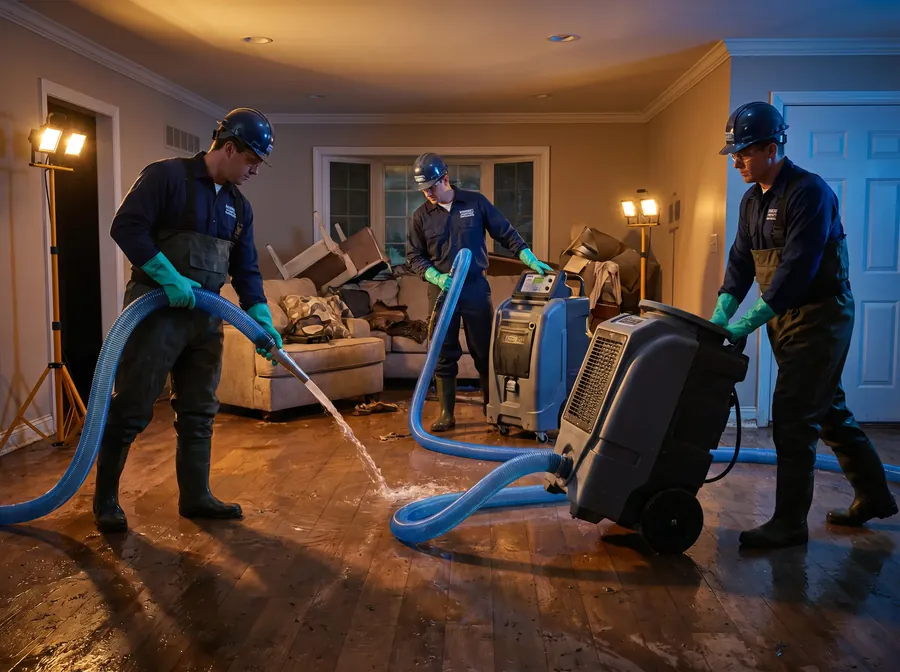
The best mold job is the one you prevent.
If materials are still wet, drying the structure inside 24–48 hours stops most growth before it starts. Crews are on call across Orange County right now.
How mold remediation actually works: step by step.
1. Assess and find the water. Moisture meters and thermal imaging, not guesswork; the wet area is almost always larger than the stain. If the source is still live it gets repaired or isolated first; remediating around an active leak spends your money twice.
2. Contain the work area. Poly barriers, sealed doorways, taped-off vents: what keeps a bathroom problem from becoming a whole-house problem when we open a wall.
3. Pull negative pressure. HEPA-filtered air scrubbers exhaust the work zone, so air flows into containment and never back into your living space.
4. Remove what can't be saved. Colonized porous materials (drywall, insulation, carpet pad, particleboard) are cut out and bagged inside containment, then carried out sealed. Framing, concrete and tile are usually cleaned and kept.
5. HEPA vacuum, then treat. Surfaces inside containment are HEPA-vacuumed and wiped, then treated with an EPA-registered antimicrobial. Note the order: the antimicrobial is the last ten percent.
6. Dry the structure. Air movers and dehumidifiers run until daily readings show framing and substrate at dry standard; skip it and the growth comes back.
7. Verify before we close it up. Visual inspection, moisture readings, photo record, written summary. On larger or insurance-involved jobs we recommend independent clearance testing by a third-party hygienist.
What not to do before we get there
Don't bleach porous surfaces. Bleach is mostly water: on drywall or wood it soaks in while the chlorine stays on top, so you lighten the stain and feed the colony underneath.
Don't run the HVAC. If growth is near the system or a return, the blower can spread spores through every duct in an afternoon. Shut it off and mention it when you call; air duct cleaning may belong in the scope.
Don't disturb the growth. No scrubbing, sanding, pulling drywall or aiming a fan at it to "air it out"; disturbance is what aerosolizes spores.
Do photograph everything. Wide shots, close-ups, the date you noticed it, any invoice from the original leak: the file your adjuster will want.
Mold and your household: the careful version.
Reactions to indoor mold vary a lot from person to person. It may aggravate allergies and asthma for sensitive people, and some report irritated eyes, nose or throat in an affected space while others notice nothing. We're a restoration company, not a medical one; if anyone at home has ongoing symptoms, talk to your doctor. On the building side: growth needs moisture, and removing it and the colonized material removes the condition.
Color tells you less than people think. "Black mold" gets the headlines, but species can't be identified by eye; the approach is set by how much area and which materials are involved.

Why Orange County homes get mold: the local suspects.
We don't have Gulf Coast humidity, which fools people into thinking mold is someone else's problem. It shows up anyway:
- Slab leaks. Pinhole copper failures are common in mid-century tracts across Santa Ana, Anaheim and Costa Mesa; water wicks up through concrete into pad and baseboard for months.
- Coastal marine layer. In Huntington Beach and Newport Beach, indoor humidity stays elevated for weeks; exterior-wall closets and garages never fully dry.
- HVAC condensate. Clogged drain lines, rusted pans and sweating attic plenums quietly wet ceiling drywall and insulation all summer.
- Atmospheric-river storms. Cracked stucco and tired window flashing put water into wall cavities that stay wet long after the sun returns.
- Post-flood shortcuts in older housing stock. A shop vac, a box fan and a weekend: the surface dried, the wall cavity didn't.
Is mold covered by insurance? Sometimes. It depends on the cause.
Carriers draw the line at sudden versus gradual. Mold from a sudden, accidental, covered water loss (a burst supply line, a failed water heater, an appliance overflow) that you reported and addressed promptly is generally treated as part of that claim. "Promptly" is doing real work there: report a loss the day it happens.
Mold traced to long-term seepage, chronic humidity or deferred maintenance is commonly excluded under gradual-damage language, and mold after rising floodwater is usually a flood-policy question. Many California policies also carry a separate mold sublimit or cover it only by endorsement, so check your declarations page.
Your adjuster makes that call, not us; what we control is the documentation that earns a fair one: dated photos, moisture readings, itemized scope. Read the full insurance guide →
What mold removal costs in Orange County
National cost guides put typical residential mold remediation between roughly $1,100 and $3,900, with many jobs near $2,400. A few square feet under a sink runs well below that; whole-home or HVAC-involved work runs well above. Those are market ranges from public cost data, not FlexPro prices.
Your number moves with affected square footage, how much material comes out, and whether structural drying or clearance testing is in scope. Your estimate is free and quoted before work begins, and when the water event behind it was covered, most homeowners face a deductible. See the full cost breakdown →
Mold removal questions.
What Orange County homeowners ask before they book.
Often you can't tell by looking, which is why we bring moisture meters instead of opinions. A stain is dry, flat and stops growing; mold comes with a musty smell, sits where there's a moisture history, and reads wet on a meter behind the surface.
Not on porous materials. Bleach is mostly water: on drywall or wood it soaks in while the chlorine stays on top, so you lighten the stain and feed the colony underneath. On tile or glass a cleaner is fine; on anything porous the answer is removal.
For visible growth with an obvious water source, testing rarely changes the plan; it still has to come out. Testing earns its keep when growth is hidden, when a landlord, buyer or adjuster wants documentation, or when you want independent clearance afterward, and for that we point you to a third-party hygienist, not the company doing the removal.
It depends on the cause. Mold from a sudden, accidental, covered water loss that you reported and addressed promptly is generally handled as part of that claim. Mold traced to long-term seepage, chronic humidity or deferred maintenance is commonly excluded, and many California policies carry a separate mold sublimit; check your declarations page. Full insurance guide →
A contained bathroom or under-sink job is often one to two days plus drying time; larger areas, attics or HVAC involvement can run several days. Most households stay put: containment and negative air keep the rest of the house usable. If relocating makes sense, we say so plainly.
National cost guides put typical residential mold remediation between roughly $1,100 and $3,900, with many jobs near $2,400; whole-home or HVAC-involved work runs higher. Those are market ranges, not our prices; your estimate is free and quoted before work begins. Full cost breakdown →
Get it looked at properly.
Suspect mold but nothing is actively flooding? Send the form and we'll get back to you fast with a free, no-obligation assessment.
Anaheim, CA 92804 (serving all of Orange County)