Water damage insurance claims, explained straight.
Whether your policy pays usually comes down to one question: was the water sudden and accidental, or did it leak for months? Here's what's covered, what isn't, how a claim moves, and the documentation that gets it approved.
- Time-stamped photo records
- Daily moisture logs
- Itemized scopes of work
- Free estimates
Does homeowners insurance cover water damage? Usually, if it was sudden.
Nearly every standard homeowners policy draws one line: was the water release sudden and accidental, or did it happen gradually? A supply line that lets go at 2 AM is sudden. A shower pan seeping into the subfloor since last spring is not. Same soaked drywall, different outcome.
That distinction decides most claims, which is why the first hour matters: the faster the source is stopped and the loss photographed, the easier it is to show this was an event, not deferred maintenance. Nothing here is a coverage opinion; read your declarations page.
What a homeowners policy typically covers
- Burst or ruptured pipes: including pinhole copper failures and slab leaks.
- Water heater failure: a tank that splits and empties 40 to 80 gallons into a garage.
- Appliance supply-line breaks: washer hoses, dishwasher lines, refrigerator ice-maker lines.
- Accidental overflows: a tub, sink or toilet that floods the floor below.
- Storm water through sudden roof damage: wind opens the roof, rain follows. Covered because a covered peril made the opening.
- Resulting damage: everything ruined downstream. Many policies won't replace the forty-dollar hose that burst, but will pay to rebuild the floor it destroyed.
What a homeowners policy typically excludes
Gradual and long-term leaks. Water that seeped for weeks behind a wall or under a cabinet: one of the most common reasons carriers deny a water claim.
Lack of maintenance. A corroded fitting you were warned about, a bulging supply hose, a roof past its service life: owner responsibility, not accident.
Groundwater and surface flooding. Rising water and runoff entering at ground level need separate flood insurance, NFIP or private. Homeowners call both a flood; insurers don't.
Sewer and drain backup. Usually excluded unless you carry a backup endorsement (typically inexpensive, and worth asking about early).
Mold, often capped. Many policies cap remediation well below the dwelling limit, and coverage is likelier when mold followed a covered loss dried quickly. See mold removal in Orange County.
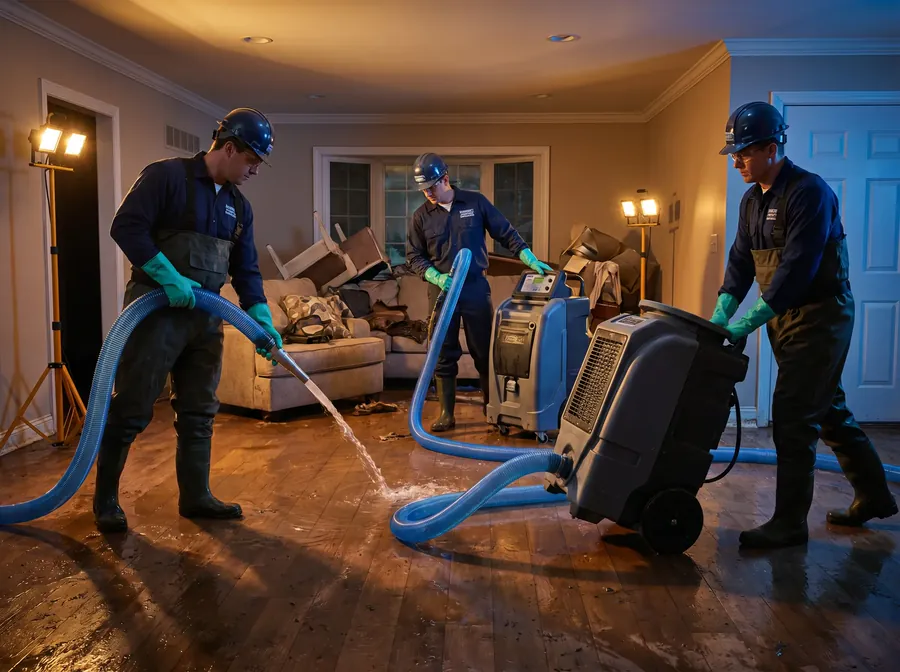
Do this in the first hour, in this order.
All of it protects two things at once: your house, and your ability to prove what happened.
Stop the water
Shut the main at the street or house valve, or close the angle stop under the fixture. Nothing dries while it's filling.
Cut power to wet rooms
Only if the panel is dry and you can reach it safely. Never wade into standing water.
Photograph before you move anything
Wide shots of each room, then close-ups of the source, the water line and every wet item. Your phone time-stamps them.
Call for emergency mitigation
Drying should start this hour, not after the adjuster visits. 1-877-GO-FLEX7 is answered around the clock.
Open the claim
Report it the same day. Write down the claim number, the adjuster's name and the date; late notice invites pushback.
Keep the failed part
Bag the split hose or cracked fitting. Physical proof the failure was sudden beats any description of it.
Water spreading right now?
Document it, then call. Mitigation started early is easier to dry, cheaper to repair and far easier to get approved.
How a water damage claim actually moves: step by step.
Six stages, in order. Most of the friction comes from doing step four before step two.
-
Step 1
Mitigate immediately
Your policy contains a duty to protect the property from further damage, so drying should begin at once; you don't need an adjuster's permission. What you must not do is demolish or discard before the loss is recorded.
-
Step 2
Document before anything is touched
We photograph every affected room on arrival, meter the moisture and map how far the water travelled, including wet cavities nobody can see. That record is the baseline the claim gets measured against.
-
Step 3
Report the loss to your carrier
Call the claims line, not just your agent, and get a claim number. State what failed, when you found it, and what you did. Prompt notice is entirely within your control.
-
Step 4
Adjuster inspection
A staff or independent adjuster walks the loss, usually within days and often while equipment is still running. We meet them on site and show the readings rather than leaving them to guess.
-
Step 5
Agree on the scope
The scope is the itemized list of what gets dried, removed, replaced and cleaned. This is where claims stall: a line item nobody documented is one nobody pays.
-
Step 6
Payment: ACV, RCV and the holdback
Actual cash value pays the depreciated value; replacement cost pays to replace. Carriers commonly issue ACV first and release the depreciation once work is invoiced. Your deductible comes off the first check.
Want the underlying numbers? See the water damage restoration cost guide for what the work itself typically runs.
The documentation that actually gets claims approved
Adjusters approve claims on evidence. Four things do most of the work:
- Time-stamped photos and video: the source, the water line, every affected room and item, before anything moves.
- Moisture readings, logged daily: values by room and material, showing how far the water reached and how it dried.
- An itemized scope of work: in the format carriers price from, not a lump-sum invoice reading "water damage repair."
- Daily drying records: equipment placement, temperature and humidity, and the date each area hit dry standard.
We produce all four on every water job and hand you the file.
Your duty to mitigate: waiting can cost you coverage.
This is the most useful thing on the page. Policies obligate you to take reasonable steps to prevent further damage. Leave standing water for three days waiting for permission, and a carrier can fairly argue the mold and ruined subfloor are damage you allowed.
You won't be penalized for calling a mitigation crew before you call your carrier. You can absolutely be penalized for doing nothing.
Deductible reality
On a covered loss your out-of-pocket is normally the deductible on your declarations page, which matters most on small losses, where damage close to that figure may not be worth a claim on your record. National cost guides put typical water damage restoration between roughly $1,300 and $6,400, averaging near $3,900 (market ranges, not our prices). Your estimate is free and quoted before work begins.
"We bill your insurance": what that should mean.
No contractor can approve coverage or is a party to your policy: you are the policyholder of record, the claim is yours, and the settlement is paid to you.
What a good restorer does is narrower: document the loss, submit an itemized scope your adjuster can price, meet them on site, and bill against the approved scope. Be wary of anyone pushing a broad assignment of benefits at the door, promising a settlement amount, or offering to make your deductible disappear; that last one is fraud, under your name.
Words to use with your adjuster
You don't need to argue. You need to be precise:
- "The failure was sudden; here's when I found it and what I did in the first hour." Ties the loss to a covered peril.
- "I have time-stamped photos and daily moisture logs from before mitigation." The scope can be verified.
- "Can you send me the scope and estimate in writing?" Including what was excluded, and why.
- "Which line items were depreciated, and what's the holdback?" What's coming now versus after completion.
- "My readings show this is still wet. Can we review them?" Invites data, not a standoff.
- "Is that based on a policy exclusion? Can you point me to the language?" Makes a denial reviewable.
Keep a claim log: date, who you spoke to, what was said. Water in the house now? Start with water damage restoration in Irvine or flood cleanup across Orange County.

Water damage insurance questions.
The six we get asked most, answered without hedging.
Most standard policies cover sudden, accidental water damage: a burst pipe, a failed water heater, an appliance supply line, or rain through storm-caused roof damage. Damage that developed slowly, like a long-term leak under a shower pan, is usually excluded as maintenance.
Generally no. Groundwater and surface water flowing into a home need separate flood insurance, NFIP or private. Water coming down from a burst pipe inside is a different peril and normally covered, though people call both a flood.
No, and waiting can hurt you. Policies place a duty on you to protect the property from further damage, so mitigation should begin right away. What you shouldn't do is discard material before the loss is documented.
Often only in part. Many policies cap mold remediation at a sublimit, and coverage is likelier when mold followed a covered loss mitigated promptly. Mold from a leak left running for months is usually denied. Mold removal →
On a covered loss, normally your deductible. If your policy pays replacement cost, the carrier typically issues actual cash value first and releases the withheld depreciation once work is invoiced. Your estimate is free and quoted before work begins. Full cost breakdown →
You are the policyholder of record and the claim is yours; no restoration company can approve coverage or promise what a carrier will pay. We document the loss, submit an itemized scope adjusters can price, and bill against what's approved.
Get it documented right.
Not urgent? Send the form and we'll get back to you fast with a free, no-obligation estimate, and a straight answer on what your carrier will likely ask for.
Anaheim, CA 92804 (serving all of Orange County)